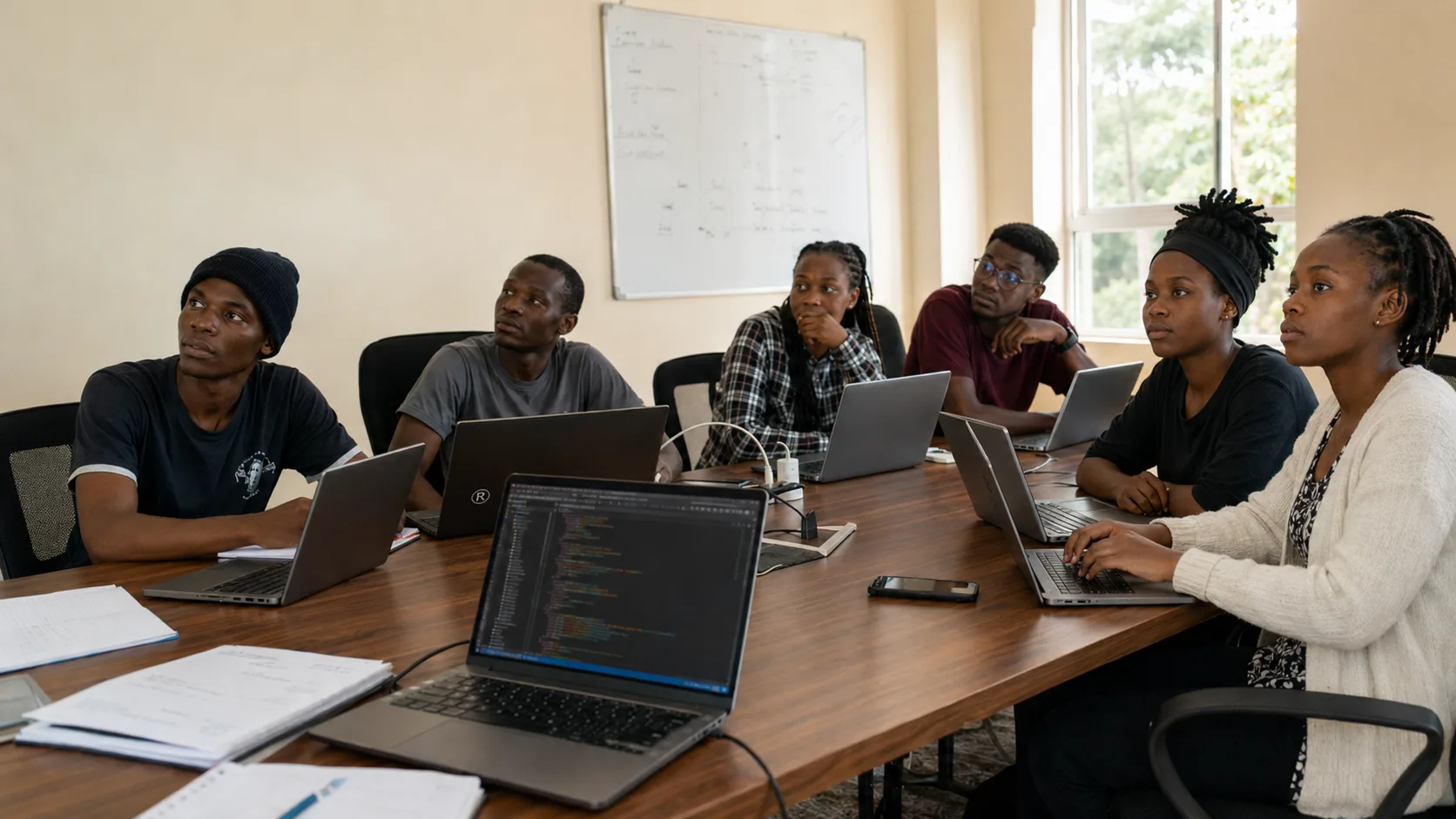
Build softwarelike a workingteam.
A one-year, full-time programme in Kisii for committed beginners ready to plan, build, test, deploy, and explain real software.
Programme facts
Built from Kenyan engineering practice
The curriculum was designed by Reduzer Technologies engineers in Kenya for students learning in Kenya. Reduzer runs the programme from Kisii and brings the delivery habits its engineers use when working for or with global companies.
First cohort in progress
The 2025 cohort graduates in August 2026. Placement claims will wait until graduate outcomes exist.
Outcomes reported clearly
Graduate outcomes will be reported by category, so placements, further training, freelance work, and other outcomes can be understood separately.
Progress sponsors can see
Progress is tracked through lessons, Code Labs, assessments, submissions, reviews, deployments, and instructor feedback. Parents and sponsors receive monthly updates on student progress.
Fit and readiness
Full-time study needs to fit your life.
The programme is built for beginners. What matters is practical readiness: a full-time year, a workable funding and living plan, steady participation, and willingness to learn real product engineering habits.
What must be in place before you start
You can give the year full-time attention.
The programme runs in person, every working day, 8am to 5pm in Kisii. It is designed around full working days in the classroom.
You have a realistic funding plan.
You need a realistic way to cover the fee and your living costs for the year. This may come from family, a sponsor, savings, an employer, a county partner, or an NGO. Because classes run every working day from 8am to 5pm, applicants should not rely on regular daytime work to fund the year.
You can make Kisii work practically.
The school is near Rongo University, where there are many hostel options and the cost of living is relatively low. You still need a practical plan for where you will stay, how you will get to class daily, and how you will attend consistently through demanding periods of the programme.
You have the basic tools to participate.
You need a reliable personal laptop and enough computer literacy to manage files, use a browser, write emails, and follow setup instructions.
Signals we look for
Persistence through difficult learning
You have tried to learn something difficult before, struggled with it, returned to it, and improved over time.
Patient use of AI
You are willing to learn how and when to use AI. You can use it as support while still doing the hard thinking, debugging, explaining, and decision-making yourself.
Clear communication
You can read and write clearly in English, ask specific questions, explain what you tried, respond to direct feedback, and keep participating.
Respect for the full product process
You are willing to think about the user, the data, the workflow, and the business goal before writing code.
This programme asks for a specific kind of commitment. We would rather help applicants see that clearly before enrolment than ask anyone to commit a year before the practical readiness is in place.
Most programmes teach code. Real product work asks for more than code.
It is possible to build projects quickly, collect a certificate, and still be unprepared for professional software work. Running code is only one part of the job. The harder question is whether the student can understand the user, model the data, make product decisions, secure the system, deploy it properly, and explain the tradeoffs.
Real delivery exposes habits a short course can hide: unclear user stories, weak data modelling, vague status, late blockers, missing tests, unsafe deployment, no analytics, and silence when the work gets difficult. New developers struggle there because they were not trained inside that kind of work.
Reduzer School is built around the quality of work expected inside a real engineering team.
What you leave with
Not just projects. A trail of product work.
A strong student should be able to explain a product from first idea to deployment: who it is for, how the data is modelled, what user flows were built, how the system was secured, how it was deployed, and how privacy, consent, cookies, and user data were handled before and after feedback.
Product thinking
Personas, user journeys, user stories, ERD diagrams, KPIs, and analytics events that show the student can define the work before writing code.
Working full-stack software
Interfaces, APIs, databases, authentication, validation, state, routing, and real user flows brought together in deployed applications.
Production habits
Security checks, staging environments, environment variables, logs, migrations, deployment notes, and handover discipline.
Compliance awareness
Basic privacy and compliance checks for user data, consent, cookie compliance, Kenya Data Protection Act expectations, and GDPR-aware product decisions.
Engineering workflow
GitHub repositories, branches, pull requests, review comments, tests, documentation, fixes, and clear status updates.
Clear next step in tech
A clearer sense of where they fit next: front-end, back-end, data analysis, QA, or another product role. Students should know how to approach a new project, ask the right first questions, and start with a plan instead of feeling lost.
Students who meet the standard through residency and capstone work are considered for the Reduzer engineering pipeline.
How training works
Students move work through a delivery system.
Reduzer School runs on its own LMS, Code Labs, Reduzer AI, visible tests, saved drafts, assessments, project submissions, and instructor review. The system is designed to make progress visible before a student drifts too far.
Students learn to move work the way a product team would: from a clear brief, through product and technical decisions, into code, checks, staging, review, fixes, and handover.
Here is what one student task can look like.
Product task · Customer dashboard onboarding flow · #128
Goal: help a new customer understand account setup progress and reduce support questions.
Shape the task
Define the persona, user journey, user story, acceptance criteria, and the KPI the feature is meant to affect.
Design the system
Plan the ERD, API contract, UI states, validation rules, analytics events, and security checks before implementation.
Build the feature
Implement the interface, API, database changes, tests, documentation, and instrumentation in a branch that can be reviewed.
Check before handoff
Run tests, handle edge cases, check auth and input validation, deploy to staging, inspect logs, and confirm the user flow works.
Review, fix, and hand over
Respond to AI-assisted and human review notes, fix what comes back, update docs, and leave deployment or handover notes.
Code Labs task #128
visible in the learning systemBrief
User story, KPI, acceptance criteria
Checks
Tests, security review, staging flow
Evidence
Drafts, comments, fixes, handoff notes
If this kind of work sounds like the standard you want, start the application.
Apply for September 2026The programme
Students learn software the way real product work is done.
From day one, students are held to the same habits Reduzer expects from its engineers: understand the user, make the work visible, write code another engineer can inspect, check security, deploy seriously, and explain the decisions behind the product.
Products start before code.
Students learn to define the user, map the journey, write user stories, plan the data model, choose KPIs, and set up analytics so the build has a reason to exist.
Code is treated like team work.
Work happens in Git, through branches, pull requests, reviews, fixes, tests, documentation, and clear status updates. The habits matter as much as the syntax.
Deployment is treated seriously.
Students carry work past a local demo into staging environments, environment variables, security checks, logs, migrations, deployment notes, and handover discipline.
Phase 0Orientation and Computing History
Orientation and Computing History
Students begin with the story behind computing: what created the need for computers, how the field escalated from calculation into networks, products, automation, AI, and global infrastructure, and where moral lines appear when software affects people.
Quality bar: They should understand why the programme is demanding, what responsible technologists must take seriously, and how to stay mentally steady when the work becomes difficult.
Phases 1–4Foundation Before Frameworks
Foundation Before Frameworks
Students start below the framework by learning how modern computers actually work: how code runs, how memory and files are handled, how operating systems organise work, and how the terminal gives them control. From there, they move into Linux, Bash, relational databases, SQL, Git, GitHub, and pull requests.
Quality bar: They should be able to model data, write useful queries, automate simple work, use Git clearly, and explain how their code and data are organised.
Phases 5–8Programming Discipline
Programming Discipline
Each student goes deep in one track: JavaScript, Python, Java, PHP, C#, or Ruby. They move from variables and control flow into OOP, files, data structures, algorithms, debugging, clean code, SOLID, tests, documentation, and communication.
Quality bar: The work should handle input, store data, fail safely, use the right structures, include tests where they matter, and be readable enough for another engineer to continue.
Phases 9–11 + Single Sprint Residency IBack-End Engineering
Back-End Engineering
Students build server-side systems with REST, ORM, OpenAPI, authentication, OWASP checks, validation, caching, rate limiting, logging, WebSockets, queues, OAuth 2.0, Docker, EC2, NGINX, Terraform, migrations, indexing, sharding, and replication.
Quality bar: A back-end submission is expected to have clear API docs, database decisions, auth and validation, security checks, logs, deployment setup, and enough structure for review and handover.
Phases 12–13 + Single Sprint Residency IIProduct Interfaces
Product Interfaces
Students learn front-end as the part of the product people actually use. They study HCI: the psychology of how humans understand, trust, and move through software. From there, they work through personas, user journeys, wireframes, semantic HTML, accessibility, colour, typography, forms, responsive CSS, React, routing, state, API data, Tailwind, testing, performance, analytics, and deployment.
Quality bar: An interface should connect to real data, support real user flows, work across screens, expose useful analytics events, and make clear UX decisions a product team can discuss.
Phases 14–15Product Delivery and Capstone
Product Delivery and Capstone
The final stretch is where students prove they can carry a product from idea to handover. They bring together requirements, user stories, ERD diagrams, KPIs, analytics setup, sprint planning, CI/CD, documentation, demos, and a full-stack capstone while also clarifying the kind of tech role they are ready to pursue next.
Quality bar: The capstone should show a working product, clear product decisions, solid engineering workflow, deployment discipline, documentation, presentation skill, and a realistic next step for the student.
Why Kisii
The location is part of the learning design.
Reduzer School runs in Nyamarambe, Kisii because the programme needs focus. The goal is to give students a serious place to do difficult work every day without the cost, commute, and noise that can break consistency before the habits are built.

Lower daily pressure
Kisii keeps the cost of the programme more realistic. The school is near Rongo University, where affordable hostels are easier to find, and daily costs like food and movement are lower than Nairobi-level pressure.
Fewer distractions
The first cohort told us they would have been more distracted if the programme was online. Being in one place, away from the usual noise, helped them stay with difficult work long enough to improve.
A better learning rhythm
The campus routine gives students structure: show up, work, ask for help, receive feedback, fix the work, and return the next day. That rhythm is hard to build alone.
Cost
KSh 192,000 for the year.
Reduzer School is a one-year, full-time, in-person programme. The fee covers the academic programme, review system, and student progress support.
The tuition is payable in three monthly installments of KSh 64,000. The first installment confirms your seat and counts toward the total tuition, not as an extra fee.
The fee is set to keep the programme accessible while maintaining the standard of work expected from every student.
Tuition includes
- One year of full-time classroom instruction
- LMS access, Code Labs, assessments, and project reviews
- Instructor feedback, progress tracking, and sponsor updates
- Residency and capstone review support
Students still plan for
- Accommodation, food, and daily transport
- Laptop, repairs, accessories, and personal data or internet
- Personal living costs while studying in Kisii
Parents and sponsors
A year of study is a family and funding decision.
The people paying for the year need clarity as much as the student applying. They need to see whether the year will be visible, structured, and worth the commitment.
Parents and sponsors receive monthly progress updates.
The update shows how the student is doing through lessons completed, Code Labs attempted and passed, assessments, project submissions, tests, deployments, feedback resolved, and instructor observation.
Problems should be seen early.
If a student starts falling behind, the goal is to notice while the gap is still small enough to address. Support is real, but the student still has to own the recovery.
The money decision should be clear.
The Cost section separates tuition from living costs, so sponsors can plan the fee, accommodation, food, transport, data, and laptop needs before committing.
Sponsors need a human contact point.
Parents, guardians, employers, county partners, NGOs, and diaspora sponsors can contact admissions before making a funding decision.
Admissions contact: +254 769 267 965 · [email protected]
Use this for sponsor questions, payment planning, and practical questions about the Kisii commitment.
Admissions
Getting in starts with how you think.
Step 1: You apply.
The application takes about 15 minutes. Tell us who you are, why this programme matters, and what you have already tried to learn or build on your own. We read every application ourselves.
Step 2: You interview and sit an assessment.
The interview and assessment help us understand how you think, how you communicate, how you reason through unclear work, and how you respond when something is difficult at first.
Step 3: We answer within 3 to 5 business days.
A clear yes or a clear no. If the answer is no, we tell you why, because a reason is more useful than silence.
Step 4: You confirm your seat and arrange payment.
The first installment confirms your seat and counts toward the total tuition. Admissions confirms the payment schedule clearly before the year starts.
Questions
Common questions.
Is Reduzer School fully in person?
Yes. The programme runs in person in Kisii, Monday to Friday, 8am to 5pm, for one year.
The in-person structure helps instructors see blockers early, review work habits directly, and keep the cohort in a steady learning rhythm.
Can I apply if I have no coding experience?
Yes. Beginners can apply if full-time study fits their life and they are ready for a demanding year.
The programme starts with Phase 0 and foundations: computing history, how modern computers work, Linux, Bash, SQL, Git, and the habits needed before application code.
Can I work while studying?
This is a full-time, in-person programme. Applicants should not rely on regular daytime work during the year.
Any outside commitment must fit around attendance, workload, recovery time, and living costs.
How much does the programme cost, and how is it paid?
Total tuition is KSh 192,000.
The tuition is payable in three monthly installments of KSh 64,000. The first installment confirms your seat and counts toward the total tuition; it is not an extra fee.
What extra costs should families plan for?
Families should plan for accommodation, food, transport, a reliable laptop, internet or data, and personal living costs.
The school is near Rongo University, so hostel options are available nearby and daily living costs are relatively lower than in major cities.
Is accommodation provided?
Accommodation is not provided by the school. Students arrange where they stay.
The school is near Rongo University, where there are many hostel options. Admissions can share local guidance before enrolment.
What laptop do I need?
You need a reliable personal laptop that can run a modern browser, a code editor, local development tools, Docker, and basic project environments.
The admissions team shares recommended specifications before enrolment.
Who built the curriculum, and who runs the programme?
The curriculum was designed by Reduzer Technologies engineers in Kenya for students learning in Kenya.
Reduzer Technologies runs the programme from Kisii and brings the delivery habits its engineers use when working for or with global companies.
How are parents or sponsors kept updated?
Parents and sponsors receive monthly progress updates from the dedicated student success team.
Updates may cover attendance, lessons completed, Code Labs, assessments, submissions, tests, deployments, feedback resolved, and instructor observations.
The student success team may also call parents or sponsors occasionally when a conversation is more useful than a written update.
What happens if I struggle and fall behind?
The programme has attendance, progress, submission, review, and feedback guidelines designed to catch problems before a student falls too far behind.
The serious gaps we have seen usually start with missed classes, missed submissions, or silence when a student is stuck.
If that happens, instructors and the student success team help identify the gap and agree on a recovery path. The student still has to attend, communicate, and do the recovery work.
Will I get a job at Reduzer when I finish?
No employment is guaranteed. Reduzer School does not guarantee employment at Reduzer or anywhere else.
Students who meet the required standard through residency and capstone work are considered for the Reduzer engineering pipeline, but entry is not promised upfront.
How will graduate outcomes be reported?
Placement claims will wait until graduate outcomes exist. The first cohort started in 2025 and graduates in August 2026.
Outcomes will be reported by category, including full-time roles, internships, freelance work, continued study, Reduzer pipeline entry, and unverified outcomes.
Why does the programme take one year?
The year gives students time to build foundations, product thinking, engineering workflow, deployment discipline, communication habits, and a full-stack capstone.
Students also use the year to understand where they fit next in tech, such as front-end, back-end, data analysis, QA, or another product role.
Apply
Apply for the September 2026 cohort.
The September 2026 cohort has 30 seats. Applications are open.
Tell us who you are, what you have tried to learn or build, and why this programme fits your life now. We read every application and respond within 3 to 5 business days, with a clear decision and a reason.
The application takes about 15 minutes.
+254 769 267 965 · [email protected] · Kisii